Showing posts with label Review: African-American Fiction. Show all posts

Friday, June 27, 2014

QUICK REVIEW: Daughters Who Walk This Path by Yejide Kilanko

Synopsis

Spirited and intelligent, Morayo grows up surrounded by school friends and family in busy, modern-day Ibadan, Nigeria. An adoring little sister, their traditional parents, and a host of aunties and cousins make Morayo's home their own. So there's nothing unusual about her charming but troubled cousin Bros T moving in with the family. At first Morayo and her sister are delighted, but in her innocence, nothing prepares Morayo for the shameful secret Bros T forces upon her.

Thrust into a web of oppressive silence woven by the adults around her, Morayo must learn to fiercely protect herself and her sister from a legacy of silence many women in Morayo's family share. Only Aunty Morenike—once shielded by her own mother—provides Morayo with a safe home and a sense of female community that sustains her as she grows into a young woman in bustling, politically charged, often violent Nigeria.


Paperback, 329 pages
Published April 10th 2012 by Penguin Canada
ISBN 0143186116 (ISBN13: 9780143186113)


About the Author
from Goodreads

Yejide Kilanko was born in Ibadan, a sprawling university city in south-western Nigeria. She read just about anything she could lay her hands on and that love for reading led her to poetry writing when she was twelve. It was the best way she made sense of the long, angst-filled teenage and young adult years that followed.

After a big, loud, African wedding, she joined her husband in Maryland, USA. For a decade she stayed home to raise their three children, moved to Canada and went back to school to become a social worker.

Yejide started writing her debut novel, Daughters Who Walk This Path, in 2009 and it was published in Canada (2012) and in the USA (2013). Prior to 2009, she didn't think she could write a novel, so she’s living proof that life can bring new dreams when least expected.

Yejide currently lives in Chatham, Ontario, where she's working hard on her second novel. Set in Nigeria and the USA, the novel will be released spring of 2014.


Check out the author's website
Follow the author on Goodreads
Follow the author on Twitter
Friend the author on Facebook 


My Thoughts
My first memory was of Eniayo. I was five years old. 
Town/Environment/Setting:

This story takes place in the city of Ibadan in Nigeria.
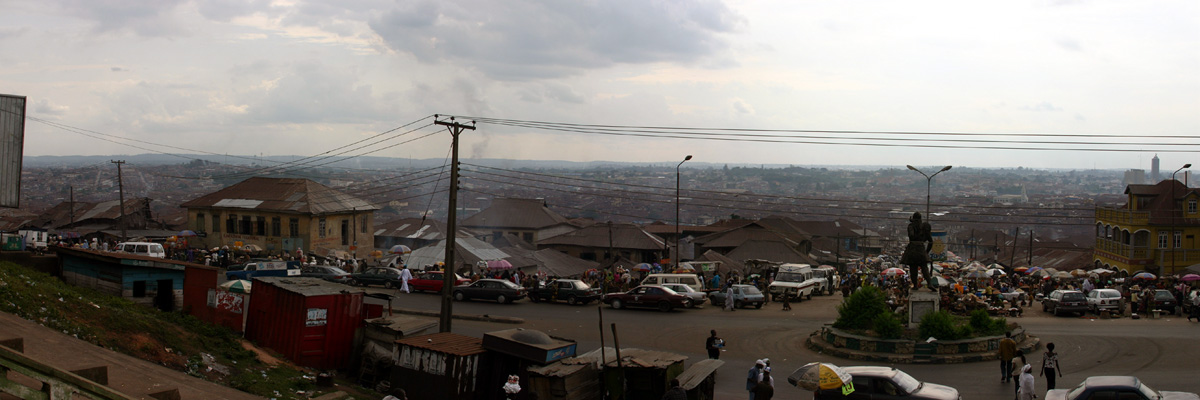
Attribution: Dassiebtekreuz at en.wikipedia
This story follows the life of Morayo, a young girl growing up in the city of Ibadan. Her little sister Eniayo is albino, and she has to deal with a certain amount of ridicule and discrimination due to her condition, especially since it is believed that albino children bring bad luck, or are a symbol of God's punishment on the family.

There is a tragic event involving Morayo and her cousin Bros T which leaves her world shaken, but she recovers with the help of her aunt Morenike, who herself suffered a tragic event as a teenager.
“Run away the instant a stranger offers you a smile,” Mummy would tell us. But no one told us that sometimes evil is found much closer to home, and that those who want to harm us can have the most soothing and familiar of voices. (p.23)
I loved the way this book gave me a taste of the culture and lifestyles of the people of Nigeria. There is a formality to relationships, in the way that the younger people bow down and prostrate themselves in greeting and respect to their elders. Even the way that wives and husbands refer to one another…
...while her mother laughed happily and knelt in front of her husband. “Daddy Ibeji, thank you. May you live to enjoy the fruits of your labour over these children.” (p. 137)
My final word: A sweet and tragic exploration of the Nigerian culture through the eyes of a young girl growing into a woman.
Aunty Morinike had explained that the sentence carved in the plaque was a quote from Nadine Gordimer. I whispered the words under my breath: “The truth isn’t always beauty. But the hunger for it is.”

Buy Now:

Barnes and Noble
Amazon
IndieBound

 My Rating: 


Disclosure:

I received a copy of this book to review through the LibraryThing Early Reviewers, in exchange for my honest opinion. I was not financially compensated in any way, and the opinions expressed are my own and based on my observations while reading this novel. The book that I received was an uncorrected proof, and quotes could differ from the final release. 

Tuesday, April 23, 2013

REVIEW: All Different Kinds of Free by Jessica McCann

Synopsis

A free woman of color in the 1830s, Margaret Morgan lived a life full of promise. One frigid night in Pennsylvania, that changed forever. They tore her family apart. They put her in chains. They never expected her to fight back. 


In 1837, Margaret Morgan was kidnapped from her home in Pennsylvania and sold into slavery. The state of Pennsylvania charged her kidnapper with the crime, but the conviction was later overturned by the U.S. Supreme Court. It was the first time a major branch of the federal government had made a pro-slavery stand, and the ruling in Prigg v. Pennsylvania sewed the bitter seeds of the states' rights battle that eventually would lead to the Civil War. 

Yet, the heart of this story is not a historic Supreme Court ruling. It is the remarkable, unforgettable Margaret Morgan. Her life would never be the same. Her family had been torn apart. Uncaring forces abused her body and her heart. But she refused to give up, refused to stop fighting, refused to allow her soul to be enslaved.

Paperback, 274 pages
Published April 2nd 2011 by Bell Bridge Books
ISBN 1611940052 (ISBN13: 9781611940053)


About the Author
re-posted from her website

I write. I live in the metro Phoenix area with my husband, two children and two dogs. And I write.

All Different Kinds of Free, my award-winning historical debut novel, was published April 2011 by Bell Bridge Books.

My reporting and creative nonfiction has appeared in a variety of magazines, including Business Week, The Writer, Phoenix, Raising Arizona Kids and ASU Research to name a few. Many corporations, universities and nonprofit organizations also tap me to write and edit dynamic communications materials.


Check out the author's website
Follow the author on Twitter
Fan the author on Goodreads
Like the book on Facebook


My Thoughts
Mama always told me bad things happen on Wednesdays, 'cause it's the middle of the week and the Lord just ain't looking then. I never really understood what she meant by that, because I thought the Lord was always supposed to be looking. But her explanation still consoled me when the goats got into the saltbox and Mr. Ashmore took the switch to me for it, or when my stomach was growling at night because rabbits had gobbled up our small garden and all we had to eat that summer was Johnnycakes.
Town/Environment:

It was hard to pick a place to highlight, as this book took place in areas across Pennsylvania, Maryland and South Carolina, and a very central scene to the story even took place at the Supreme Court in Washington D.C. However Margaret grew up as a young girl on the Ashmore place in Maryland, and Mr. Ashmore built a water mill where her father worked, and I liked this picture.
By Gabor Eszes (UED77) (Own work) [GFDL (http://www.gnu.org/copyleft/fdl.html), CC-BY-SA-3.0 (http://creativecommons.org/licenses/by-sa/3.0/) or CC-BY-SA-2.5-2.0-1.0 (http://creativecommons.org/licenses/by-sa/2.5-2.0-1.0)], via Wikimedia Commons
Margaret grew up as a free black woman in the south, born to two slaves who were freed by their owner before she was born. She marries an ex-slave who is now free, and they move north, settle their own homestead and have a few kids. They have a wonderful life together. Then Margaret is kidnapped by a man sent by her parents' previous owner, who claims that she is a runaway slave.

Based on real historical characters, this is one of those absorbing stories that can keep you on the edge of your seat, wondering what will happen to Margaret and her children.

The author reveals at the end of the book how this book came about.
The references you will find to Prigg v. Pennsylvania in history books are typically brief and lack details about the people involved. They generally emphasize that its controversial ruling fanned the early sparks of contention that eventually led to the Civil War. The history books will have you believe that is why the story of Prigg v. Pennsylvania is important.

Yet, from the moment I first learned of Prigg v. Pennsylvania, I believed the story was important because it began with Margaret-- with one woman's fight, against all odds, to hold her family together.

According to the published Supreme Court opinion for Prigg v. Pennsylvania, Margaret Morgan escaped a life of slavery in Maryland when she fled to Pennsylvania in 1832. She lived there several years before being abducted by Edward prigg and returned, along with her children, to her owner Margaret Ashmore. Prigg was brought up on charges for violating the Pennsylvania Personal Liberty Law, which had been created to protect free blacks from kidnapping.

According to several other public records, however, Margaret had lived her entire life as a free woman. The court opinion failed to note that she had married a free black man from Pennsylvania many years before she left Maryland and that she had not been listed on John Ashmore's deed of property at the time of his death. Margaret was not itemized as part of the inheritance to his widow or to his daughter, as was all his other property. In fact, in the 1830 U.S. census, she, her husband and their children were recorded as "free blacks" by the county sheriff.
Little else is known about Margaret, other than the fact that she lost the case against Pennsylvania that concerned her. This book speculates about how her life may have gone.

Margaret is a strong woman, living a blessed life with her husband and children, when Edward Prigg forcibly takes her and her children from her home and returns her to the widow of the man who once owned her parents.

I really enjoyed this story, although there were a few characters that seemed to have been inserted into the story for no real purpose, such as the character of Rose McFarland. She was a spirited and intelligent young woman that I would have been interested in getting to know better, but instead she was introduced briefly and then disappeared from the story again. It left me wondering why make a character so intriguing and likable just to have her be a momentary distraction?

My final word: Simple and unadorned, this hard-hitting story will leave you rooting for Margaret and her family, hoping against hope that she regains the freedom stolen from her. If you like fictional stories about slavery and the struggle to overcome, pick up this book!

Buy Now:

Amazon
Barnes and Noble


Cover: B
Writing Style: B+
Characters: B+
Storyline/Plot: A-
Interest/Uniqueness: A-

My Rating:


Disclosure:

I received a copy of this book to review through the LibraryThing Early Reviewers, in exchange for my honest opinion. I was not financially compensated in any way, and the opinions expressed are my own and based on my observations while reading this novel.

Monday, April 1, 2013

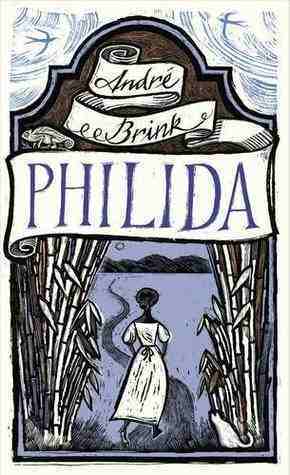
REVIEW: Philida by Andre P. Brink

Synopsis

Soon there must come a day when I can say for myself: This and that I shall do, this and that I shall not.

Philida is the mother of four children by Francois Brink, the son of her master. The year is 1832 and the Cape is rife with rumours about the liberation of the slaves. Philida decides to risk her whole life by lodging a complaint against Francois, who has reneged on his promise to set her free.

His father has ordered him to marry a white woman from a prominent Cape Town family, and Philida will be sold on to owners in the harsh country up north. Unwilling to accept this fate, Philida continues to test the limits of her freedom, and with the Muslim slave Labyn she sets off on a journey across the great wilderness on the banks of the Gariep River, to the far north of Cape Town. Philida is an unforgettable story of one woman’s determination to survive and be free.


Paperback, 320 pages
Published February 5th 2013 by Vintage (first published July 31st 2012)
ISBN  0345805038 (ISBN13: 9780345805034)


About the Author

André Philippus Brink is a South African novelist. He writes in Afrikaans and English and was until his retirement a Professor of English Literature at the University of Cape Town.

In the 1960s, he and Breyten Breytenbach were key figures in the Afrikaans literary movement known as Die Sestigers ("The Sixty-ers"). These writers sought to use Afrikaans as a language to speak against the apartheid government, and also to bring into Afrikaans literature the influence of contemporary English and French trends. His novel Kennis van die aand (1973) was the first Afrikaans book to be banned by the South African government.

Brink writes his works simultaneously in English and Afrikaans.

Brink's early novels were often concerned with the apartheid policy. His more recent work engages new issues raised by life in postapartheid South Africa.


My Thoughts
Here come shit. Just one look, and I can see it coming.  
Town/Environment:

This story takes place in South Africa.

This story takes place during 1832 in Cape Town and the surrounding area, as there is talk of freeing the slaves. Philida is one of these slaves, and the young mother of four children (two still alive). The father of the babies is Francois, the master's son. When Philida charges Francois with fathering her children upon promises (and lies) that they will be together, her life is lost in upheaval.

This was one of those tough stories. I generally love stories about slavery and the struggle for survival and freedom, but the clipped and rambling speech pattern in this book did not endear me to the story. Likewise the characters did not endear me to the story.

A little over halfway through, there was a hideous passage that outlined the inventory of the master Cornelius, reminiscent of the chapter from the bible that outlines whom beget whom...
...4 chairs, 1 hearth chain, 1 water kettle, 1 copper colander, 1 fire iron, 1 three-legged pot, 2 iron forks, 1 skimming spoon, 1 small hatchet... (page 169)
... and it went on for pages. But there were some passages that struck me or moved me.
I’m getting old. One cannot see it in what one does but in what one can no longer do. (page 78)
 An eye for an eye and a child for a basket of figs. (page 101)
It’s no use crying in the rain, my child, because no one will see your tears. (page 122)
I found that last one especially striking.

One thing that I found interesting was the fact that the slaves are always barefoot in the book. They are not permitted to wear shoes. Something as mundane as shoes becomes this wondrous thing that they dream of having, as they represent freedom and being able to travel where you wish.

I have to point out that I hate when books use foreign words, and don’t translate them. Oubaas, Baas, Ounooi, riem, kierie, meid, Nooi-- all words commonly used in the book without ever explaining what they mean. I have a general idea, but I like to know the literal translation-- not the simple “feeling” of the word.

This book is often brutal and vulgar in its depictions of rape and abuse, human degradation, and man’s lascivious bent.

My final word: Reading this story was like talking with someone who has a bad case of ADD. It was rambling and a little all over the place, and I had a hard time following it. Most of the characters were not likable. The master Cornelius was despicable, Francois was a spineless and selfish twit, Philida left me somewhat ambivalent. The story is filled with great brutality, and very explicit in some violent descriptions. This book is definitely not for everyone. I just had a hard time really liking it, and that was a real bummer, because I really wanted to love this one.

Buy Now:

Amazon
Barnes and Noble

My Rating:


Disclosure: